
About thirty minutes
A short look at Systems Leadership.
A short summary of key concepts and ideas from the PA Systems Leadership Playbook before your upcoming class. Each tool has one main resource, a plain-language summary, and one question to hold onto.
Before the tools
Frame: Systems Leadership
Why Systems Leadership?
Because many work and community challenges are not isolated Events. They are produced by Patterns, relationships, Systemic Structures, and assumptions that keep interacting.
A short orientation.
In everyday PA work, it is natural to respond to what is most visible: a late submission, a missed target, a tense meeting, a quiet stakeholder, or a decision that did not land well.
Systems Leadership helps us slow down and look at what keeps producing the visible Event. It asks how people, incentives, routines, information flows, relationships, and beliefs are connected.
This matters because effort alone can sometimes leave the Pattern unchanged. A team can work harder, communicate more, or add more checks, but still get the same result if the underlying system keeps pulling people back into the same behaviour.
The PA Systems Leadership Playbook frames this as part of building a Learning Organisation: developing aspiration, generative conversations, and understanding complexity so we can create the future we desire.
The goal of this preview is not to turn you into a systems expert before class. It is to give you shared language for noticing patterns, asking better questions, and examining your own thinking before acting.
Source note. This framing is aligned to the PA Systems Leadership Playbook, which anchors Systems Leadership in Peter Senge's Learning Organisation disciplines and three types of mastery: Creation Mastery, Collaboration Mastery and Complexity Mastery.
Read the PA Systems Leadership Playbook ↗Hold this question
As you move through the tools, notice one real situation where the visible problem may be only the surface.
One of six
Tool: Levels of Perspective
Levels of Perspective (Iceberg Model)
Look at the same situation from different depths: Events, Patterns, Systemic Structures, Mental Models, and the deeper Vision we will work on in class.
Watch for
In PA, we call this Levels of Perspective. Some of you may recognise it as the Iceberg Model. Watch how the littering example moves from the visible incident to deeper forces.
Levels of Perspective, also known as the Iceberg Model. The video uses a littering situation to show that what we see is only the top.
Open on YouTube ↗So here is the idea.
Levels of Perspective helps you avoid staying only at the Event level. Events are the immediate, visible things we can point to: the complaint, the missed deadline, the low turnout, or in the video, litter on the ground.
The playbook then asks us to look below the surface. Patterns are what keeps happening over time. Systemic Structures are the policies, processes, routines, information flows, and physical arrangements shaping those Patterns. Mental Models are the beliefs and assumptions that keep those structures in place.
The video makes this concrete: littering is not only about one person dropping one item. We can ask where it keeps happening, what makes disposal easier or harder, and what assumptions people hold about shared responsibility for the space.
There is a fifth, deeper layer, Vision, which we work on together in class.
A quick read of the littering example:
- Events: litter is seen in a public space.
- Patterns: littering keeps recurring in certain places or after certain activities.
- Systemic Structures: bin placement, cleaning routines, enforcement, signage, crowd flow, and convenience shape what people do.
- Mental Models: people may assume "someone else will clean it", "one small item does not matter", or "cleanliness is the cleaner's job".
- Vision-in-use: taken together, these Mental Models may point to an unspoken current vision where responsibility for shared spaces is outsourced. In class, we compare this with the desired Vision we want to create.
Source note. In the PA Systems Leadership Playbook, the Levels of Perspective framework sits under Complexity Mastery and helps leaders move from Events to Patterns, Systemic Structures, Mental Models and Vision.
Read more in the playbook ↗Before you move on
Think of a problem at work that keeps coming back. Which level have you mostly been working at?
Two of six
Tool: Creative Tension Model
Creative Tension Model
Hold the gap between current reality and desired future, long enough for the gap to guide action.
Look for
The two ends of the stretch: where you are now and where you want to be. The useful work begins by keeping both visible.
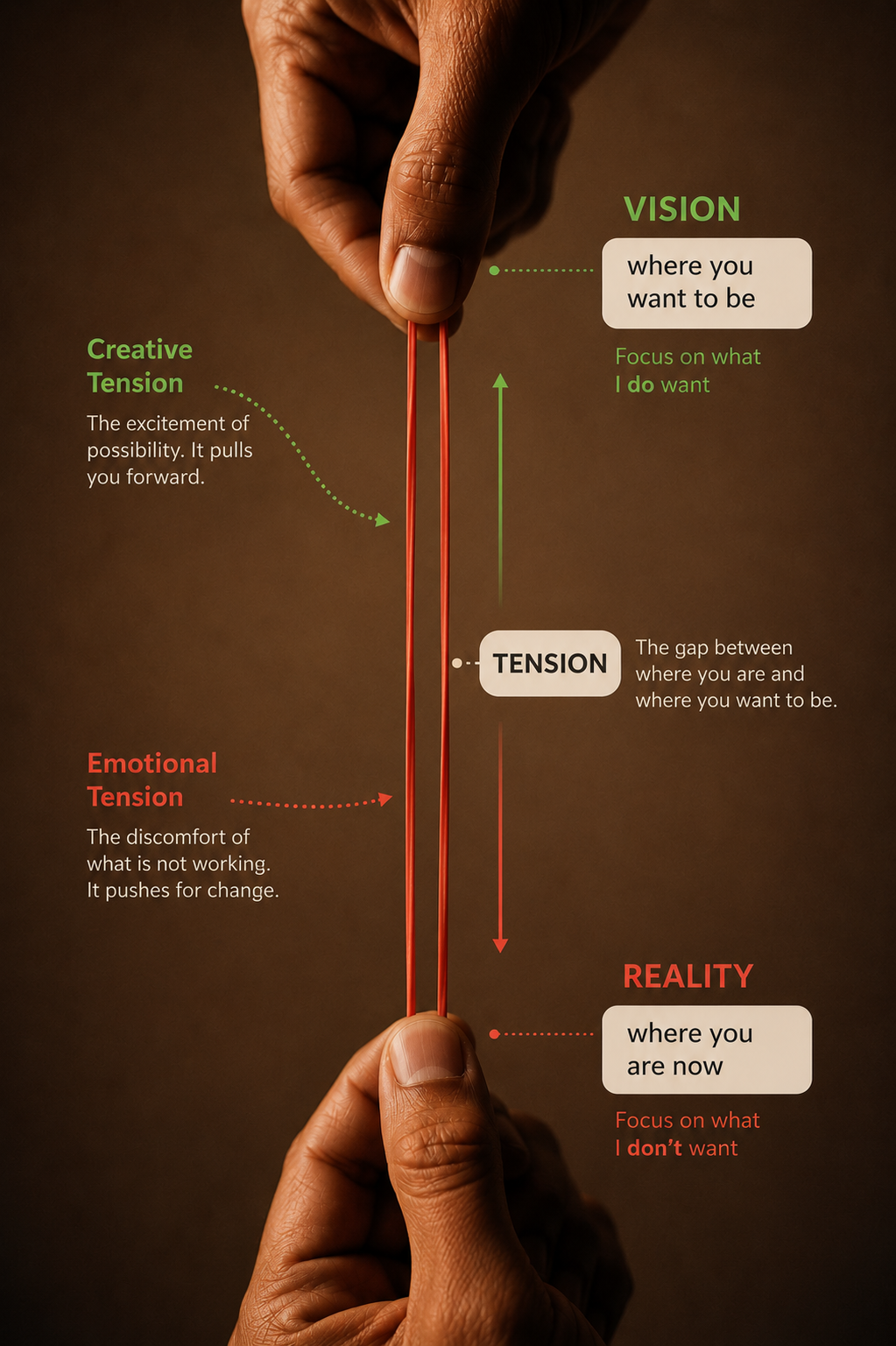
Creative tension holds vision and reality together. Emotional tension is the discomfort we feel inside that gap.
Listen for
The difference between using the gap to learn and quietly lowering the goal so the discomfort goes away.
Peter Senge on the gap. The man who wrote the book explains it in three minutes, in his own voice.
Open on YouTube ↗So here is the idea.
The Creative Tension Model belongs to Creation Mastery. It helps leaders create desired futures instead of simply making current problems go away.
Creative tension is the pull between two honest statements: what is true now, and what you want to create.
The same gap can also create emotional tension: frustration, anxiety, defensiveness, or impatience because current reality is not yet where you want it to be.
There are two common ways to resolve the tension. One is creative: keep the vision steady, face current reality clearly, and learn or act so reality moves closer to the vision. The other is relief-seeking: lower the vision, soften the facts, distract yourself, or explain the gap away so the discomfort fades.
The practice is to notice the emotional pull without letting it quietly shrink the goal. Hold both sides clearly: current reality and desired future, then choose actions that move reality towards the vision.
Source note. In the PA Systems Leadership Playbook, the Creative Tension Model is part of Creation Mastery and draws on Peter Senge's work on personal mastery and shared vision.
Read more in the playbook ↗Before you move on
Where have you, or your team, quietly lowered a goal to make the discomfort go away?
Three of six
Tool: Core Theory of Success
Core Theory of Success
The quality of results improves through a reinforcing loop: relationships shape thinking, thinking shapes actions, actions shape results, and results shape relationships.
So here is the idea.
Core Theory of Success is a practical loop for Collaboration Mastery. Daniel Kim frames it as a reinforcing engine: results are shaped by more than action alone.
When the quality of relationships improves, people share more perspectives and the quality of thinking improves. Better thinking supports better coordinated actions. Better actions improve results. Better results can then strengthen relationships.
In PA's playbook, this connects to outcomes such as stronger cross-functional collaboration, better organisational alignment, adaptability, innovation, and the ability to identify high-leverage interventions.
Source note. In the PA Systems Leadership Playbook, Core Theory of Success sits under Collaboration Mastery and is adapted from Daniel Kim's work on quality of relationships, thinking, actions and results.
Read more in the playbook ↗Before you move on
Which part of the loop is weakest in your team right now?
Four of six
Tool: Inquiry and Advocacy
Inquiry and Advocacy
Balance genuine curiosity with clear sharing of your own thinking, so conversations become more generative.
Watch for
How disagreement becomes useful when people make their thinking visible and stay curious about what others are seeing.
Margaret Heffernan: dare to disagree. The useful version of disagreement is not argument for its own sake. It is a way to test what one person cannot see alone.
Open on TED ↗Inquiry
Use this when you want to understand another person's data, meaning, concerns, or assumptions.
"Could you help me understand what led you to see it that way?"Advocacy
Use this when you need to share your point of view and make your reasoning visible.
"Here is what I am seeing, the data I am using, and the assumption I may be making."Balancing both
Use this when you have a view, but want to test it and invite a different perspective. It is advocacy followed by inquiry.
"Here is how I am interpreting it. What might I be missing?"So here is the idea.
Inquiry and Advocacy is a practice for improving the Quality of Conversations. It matters when people are seeing the same situation differently, when a conversation feels stuck, or when we need to slow down our own reaction before responding.
Inquiry opens up perspectives. Advocacy makes your own perspective visible. Balancing both helps the conversation move from defending positions to testing thinking together.
Deep listening is the foundation. With deep listening, inquiry becomes curiosity rather than interrogation, and advocacy becomes an invitation to understand rather than convince. This sets the ground for the Ladder of Inference work we practise in class.
Source note. In the PA Systems Leadership Playbook, Balancing Inquiry and Advocacy is part of Quality of Conversations under Collaboration Mastery, drawing on organisational learning and action-science practice.
Read more in the playbook ↗Before you move on
In your last disagreement, were you mostly advocating, mostly inquiring, or balancing both?
Five of six
Tool: Mental Models
Mental Models
Deep assumptions, beliefs and pictures shape how we understand the world and respond to situations.
Try it as you watch
Play along with the number rule. Notice whether you test your first idea, or mostly look for evidence that confirms it.
Veritasium: the most common mistake your mind makes. Veritasium is a science education channel. This simple guessing game shows how people search for evidence that fits the answer already in mind.
Open on YouTube ↗So here is the idea.
Mental Models are deeply ingrained assumptions, beliefs, generalisations, pictures or images that influence how we understand the world and respond to situations.
In work settings, Mental Models might sound like: "this unit prefers detail", "that stakeholder moves carefully", or "this issue is mainly a resourcing problem". Any of these may be partly true. The question is whether they have been checked recently.
The playbook places Mental Models under Collaboration Mastery because surfacing them helps people create shared understanding and tap collective wisdom.
They are also one of the deepest levels in Levels of Perspective. If a belief keeps shaping the same pattern, changing the surface action may not be enough.
Source note. In the PA Systems Leadership Playbook, Mental Models are one of the Learning Organisation disciplines and a Collaboration Mastery tool for recognising assumptions, beliefs and attitudes.
Read more in the playbook ↗Before you move on
Name one work belief that may be useful, but should be checked again.
Six of six
Tool: Ladder of Inference
Ladder of Inference
Use this final tool to slow down the jump from observable data to beliefs and actions.
Watch for
How quickly the mind moves from what it notices, to the meaning it adds, to what it does. The class terms below simplify the labels from the video.
TED-Ed: Rethinking Thinking. The lesson introduces the Ladder of Inference as a process for rethinking how we interpret interactions.
Open the TED-Ed lesson ↗Actions. What we do, say, avoid, or decide.
Beliefs. What this seems to confirm about people, work, or the situation.
Conclusions. The judgement we arrive at.
Assumptions. The story we add to connect the dots.
Add Meaning. The meaning we make from selected data.
Select Data. The slice of available data we notice and use.
Pool of Available Data.Everything that could be observed, asked, checked, or learnt.
Reflexive loop
Our beliefs affect which data we select next time.
So here is the idea.
The Ladder of Inference describes how quickly we move from observable data to action. We do not take in everything. We select some data, add meaning, form assumptions, reach conclusions, reinforce beliefs, and then act as if our view is the whole picture.
This is useful because it separates what happened from the meaning we made from what happened. The meaning may be reasonable, but it is still worth checking before we act strongly.
In PA work, this matters when we interact with residents, manage community feedback, work with partners and stakeholders, or design engagement programmes.
There are two directions to remember. In real life, we usually climb up the Ladder of Inference in seconds. In reflection, we deliberately walk down from our action to the data we selected. Then we expand the pool of available data and choose a more grounded next action.
Source note. In the PA Systems Leadership Playbook, the Ladder of Inference is part of Collaboration Mastery and helps us examine how Mental Models are formed and reinforced.
Read more in the playbook ↗What happens automatically
We climb up.
Something happens. We notice part of it, add meaning, form an assumption, draw a conclusion, update a belief, and act. This is fast and often outside awareness.
What the tool helps us do
We walk down.
Start from your action or reaction, then trace the thinking back down: belief, conclusion, assumption, meaning, selected data, and the wider data pool.
What comes next
We widen the data.
Ask what else may be true, what data is missing, who else may see it differently, and what action would still help if your first assumption is only partly true.
Video example
The parking lot Ladder of Inference, using class terms
The first pass shows the fast climb. The driver takes the lot, we select a few details, add meaning and a story, and move toward confrontation.
Actions. You move behind the car, honk, and prepare to confront the driver.
Beliefs. This reinforces a belief that if you do not stand up immediately, people will take advantage.
Conclusions. You conclude the driver is inconsiderate and should be challenged.
Assumptions. You assume the driver saw your signal, ignored it, and decided their need mattered more than yours.
Add Meaning. You read the move as deliberate, disrespectful, and aimed at you.
Select Data. You focus on being cut off, the brake, your tightening grip, and the driver looking away.
Pool of Available Data.A car moves into the parking spot. Your signal was on. You brake. The driver looks away. Other data is not yet known, including why the driver is rushing.
Then new data enters the pool: the driver's wife is in labour. That does not mean the first reaction was foolish. It shows why the Ladder of Inference is useful. When the data pool widens, the meaning changes, the assumption changes, the conclusion changes, and a different action becomes possible.
Questions that help you change the action:
- What did I actually observe, and what did I add?
- What meaning did I add before I checked it?
- What data did I select because it matched my belief?
- What else could explain this situation?
- What data would I need before acting strongly?
- What action would still be useful if my assumption is only partly true?
Before you move on
Think of one work moment where you moved quickly from what happened to what you did. What data did you select, and what data might still be outside your view?

That is the six tools.
You have the preview for the upcoming class.
- 1Levels of Perspective
- 2Creative Tension Model
- 3Core Theory of Success
- 4Inquiry and Advocacy
- 5Mental Models
- 6Ladder of Inference
Together, these tools preview the three types of mastery in the PA Systems Leadership Playbook: Creation Mastery, Collaboration Mastery and Complexity Mastery. In class, we practise Balancing Inquiry and Advocacy and use these tools on one real situation you can look at with more curiosity.
Your task
Bring one real situation to class.
Choose a real work, community, or personal situation you want to work on, improve, or understand better. It may include a moment of tension, frustration, confusion, or strong reaction, but it does not have to be dramatic. You do not need to analyse it with the Ladder of Inference yet. Describe what happened from your perspective, then turn it into a poster you can bring into class. On the day, you will look at this with the Ladder of Inference, with a partner.
Choose something safe enough to share
- You may bring a work, community, or personal situation, or a less sensitive version of something real.
- Choose something you are comfortable bringing into class. You can anonymise names, teams, and details.
- No need to solve it or decide who was right. For now, capture the scene clearly enough that another person can understand your perspective.
Progress saves on this device as you go.
Please complete the fields marked Required before copying your prompt.
That is the whole preview. See you in class.